Diagnosis
Why your kart runs wide on corner exit
It's the most common thing telemetry shows in a kart — and usually the corner costing you the most. Here's how to get the kart to drive off the corner instead of out of it.
What “runs wide on exit” actually means
As you pick the throttle back up, the front tires give up grip before the rears. The kart stops turning as tight as you're asking and washes out toward the edge of the track — so you can't use the curb, and you arrive on the straight slower than you should. That's understeer on exit; in Lapnotes it's the corner tagged runs wide on exit.
In the dataWhat it looks like on the trace
You're looking for a specific signature, not a feeling. Three things line up when a corner runs wide on exit:
- A rounded, drawn-out minimum speed. Instead of a sharp dip and recovery, the bottom of the speed trace sits flat — you're holding a low speed longer than you should because you can't get the power down.
- A late return to throttle. The throttle trace climbs back to 100% well after the apex. That gap between apex and full throttle is the time you're giving away.
- Speed deficit that grows down the straight. On the delta, the loss doesn't stop at the corner — it keeps widening into the next section because you started accelerating late.
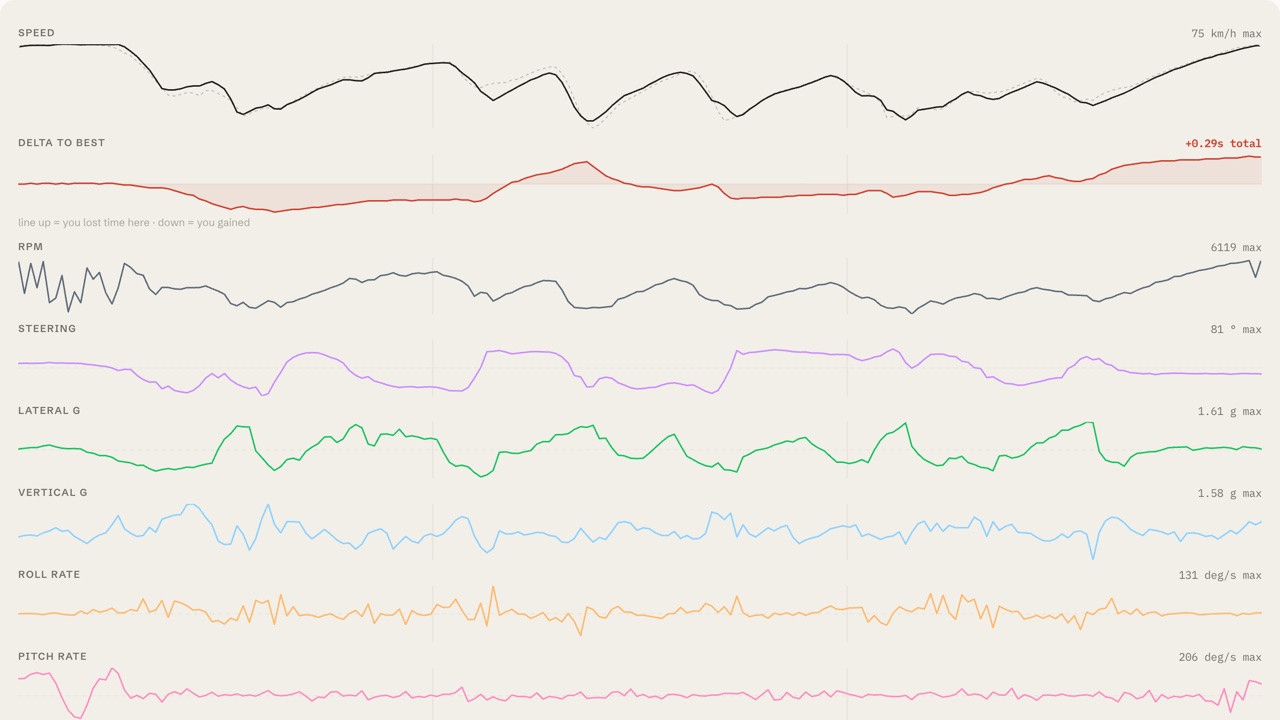
If the kart won't turn in — wide at the apex, not just the exit — that's an entry problem, and the fix is different (usually brake balance or how you release the brake). Exit understeer is specifically about not being able to get back to power. Check where on the trace the kart goes wide: before the apex, or after.
Why it costs more than it feels
A corner exit feeds a straight, and a straight multiplies whatever speed you leave the corner with. Lose a tenth on exit and you carry that deficit the whole length of the next straight — which is why exit corners almost always sit at the top of the time-lost ranking. (In the sample session, the three most expensive corners are all “runs wide on exit” — a textbook recurring pattern.)
CausesWhere it usually comes from
Exit understeer almost always comes from one of four places. Work down the list — they're roughly in order of how often they're the real culprit.
| Cause | What's happening | First thing to try |
|---|---|---|
| Too much entry speed | You arrive too hot, the front washes out, and the kart can't rotate for the exit. | Brake a touch earlier; aim for a higher, cleaner minimum speed. |
| Throttle too early / too hard | Power before the kart has rotated pushes the front straight on. | Wait for the nose to point at the exit, then squeeze — don't stab. |
| Wrong line | Early apex points the kart at the outside curb too soon. | Apex later; sacrifice entry for a straighter, earlier-throttle exit. |
| Chassis / tires | Too much grip at the front, or rear tires gone off, won't let the back come round. | Widen the rear track or check rear tire temps & pressures. |
Notice that three of the four are free — they're driving, not parts. The most common expensive-looking problem is usually fixed with a change you can make on the next run, for nothing. Here's the order I work them in.
First, rule out your line
Most exit push is a line problem before it's a setup problem. Turn in too early and you apex early — which means you're still turning at the exit, asking the front to grip at the exact moment you want to feed power. It can't do both. A slightly later, tighter apex points the kart straighter sooner, so by the time you're hard on the throttle the steering is already coming off.
Then, your throttle
Picking up the throttle while the front is still loaded is what tips it into a push. Be patient and let the two trade off: unwind the steering as you feed the power, not before it. Slow hands first, then squeeze. If you have to lift back off mid-exit, you got greedy a beat too early.
Look where you want to go
Your hands follow your eyes. Snap your vision to the exit — the point you want the kart to end up — rather than fixating on the apex, and the line opens up almost on its own. It sounds soft; it's the cheapest exit speed you'll find.
Still pushing? Now it's a balance question
If your line and throttle are honest and a corner still runs wide, it's setup. A kart has a solid rear axle and no differential, so it has to free up — lift the inside rear slightly — to rotate; when it doesn't, it scrubs and pushes. The usual directions are to help the rear rotate (a narrower rear track, a softer or shorter axle, a touch more rear ride height) or to add front grip (front track, camber, caster). Tires, track and temperature all move the answer, so treat your chassis manufacturer's setup guide as the source of specifics — and change one thing at a time, then re-measure. One change, one run, check the data. Chasing two at once just hides which one worked.
ProofHow to know you've actually fixed it
Feel lies; the clock doesn't. Re-run the same corner next session and watch its time-lost shrink — that's the verdict, and it's the whole point of tracking a corner across visits rather than chasing a new feeling every time out. If the time lost drops by more than 0.03s versus your last clean visit, it's real — not noise. More on that workflow in how to read your telemetry.
Set this corner as your focus. Next session at the track, the debrief opens with the verdict — “T4 · Hairpin: ▼ 0.10s better — it's working” — measured from your own laps, the same corner remembered every visit. No re-reading the squiggles to find out.
Lapnotes does the diagnosis for you — it finds the corner, names the cause in plain English, and tells you whether it's improving. See it on a real lap, or export your own .xrk and check your exits.
Find your most expensive corner
Lapnotes ranks every corner by the seconds it's costing you and names what the kart is doing — runs wide, won't turn in, tail steps out — in plain English.